
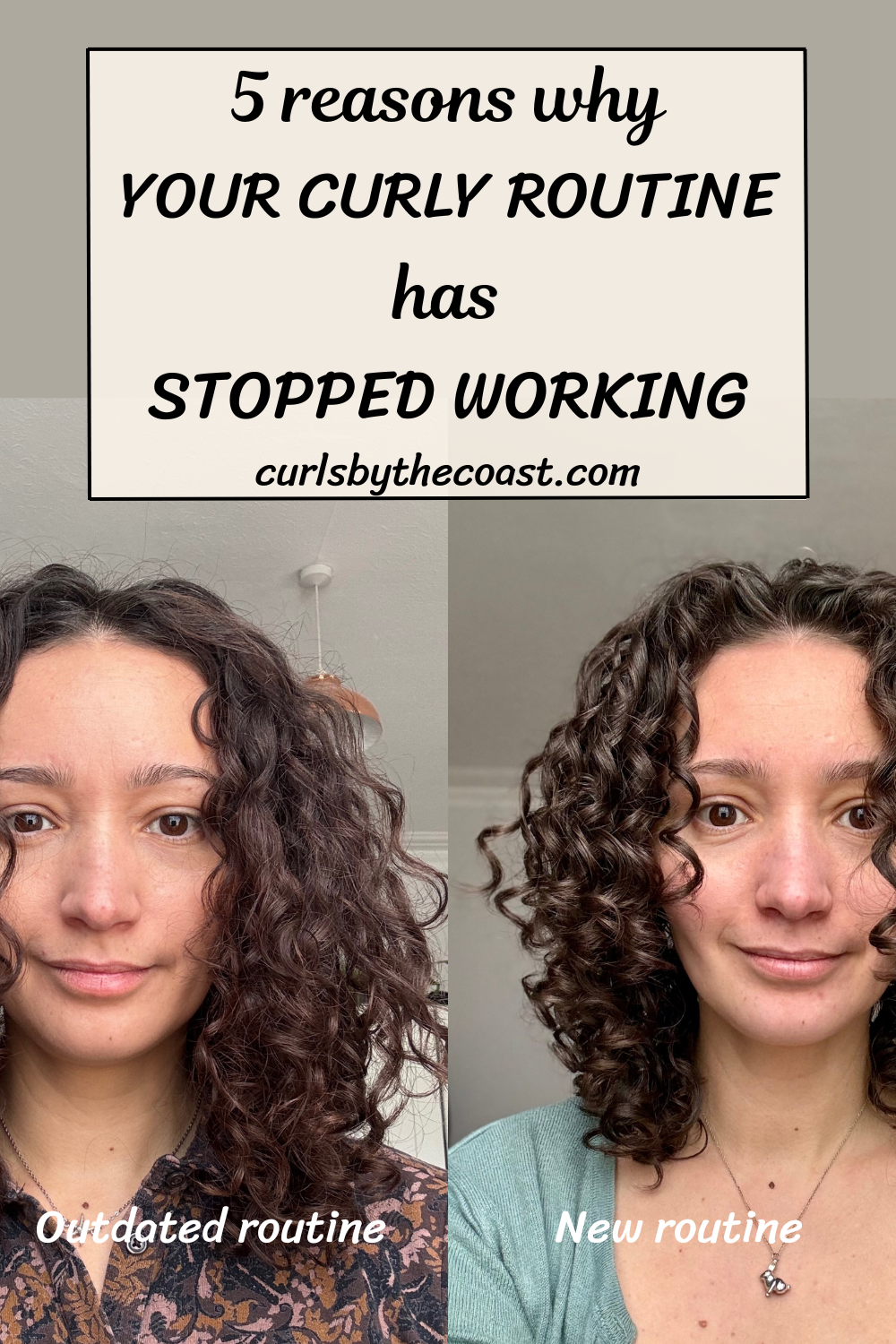
Isn’t it typical? You go through a whole load of trial and error trying to find a curly routine that works for you and gives you defined curls, and a few months or years later it suddenly stops working. Your curls are frizzy, tangly, or just non-existent. Why does this happen? There are lots of possible explanations, but below are some of the most popular reasons why your curly routine isn’t working for you any more.
Your curls are now healthier
When you first start looking after your curls, it’s common to be recovering from some damage at the same time. Perhaps you used to straighten your hair a lot, it has bleach damage, or you used to overbrush it and tie it up too tightly.
As a result, when you’re just starting out, you often need a lot of conditioning to help repair the damage: deep conditioners, bond builders, curl creams, and even co-washes.
However, once your curls get healthier, this high-conditioning routine can become too much, and leads to overconditioned hair, causing your curls to fall flat and go fluffy and limp after just a few hours.
What to do: if you have virgin hair or you’ve been doing the same curly routine for several months, and you aren’t getting the definition you used to, try cutting out some of the more conditioning products in your routine.
Perhaps you don’t need to deep condition as often (or at all!), and perhaps you can skip the curl cream and go straight to your mousse or gel.
Make sure you’re clarifying occasionally too, to remove buildup on your scalp – you might find that even your shampoo doesn’t need to be as moisturising anymore. This lower amount of conditioning can help your curls hold their structure better.
The seasons or climate have changed
Curls are obviously affected by the rain and humidity, but they can also get damaged by dry conditions and strong sun as well.
The sun degrades the proteins in our hair, causing our hair to become weaker, and certain stylers that are high in glycerin can cause more frizz in very humid or very dry environments.
In humid climates, the glycerin grabs onto extra moisture in the air, while in very dry air, it actually pushes it from your hair into the air! Both actions lift your hair strands and cause that halo frizz.
What to do: Pay attention to how your hair behaves in different weathers and seasons and adjust your routine accordingly.
Perhaps you have very dry winters and the central heating dries out your hair too, in which case you need to use a curl cream or a thicker conditioner to help hold the moisture in your hair.
Or maybe you live in the UK like me and it rains for 8 months straight, so anti-humidity stylers will be your best friend – sealing your strands from unwanted extra moisture.
For more info and some product recommendations, check out my post How to tweak your curly hair routine for the summer (or winter).
You need a haircut
Believe it or not, your curly routine can stop being effective if you’ve gone too long without a haircut. The ends of our hair are the oldest parts and have undergone the most wear and tear, so are likely to be very dry and more prone to split ends. They can also start to look straggly.
Meanwhile, for some curlies, their hair can get heavy and weighed down the longer it gets, which means they can struggle to get volume or bounce in their curls if it gets too long.
What to do: Get a haircut! It doesn’t have to be drastic, but trimming your straggly ends and getting some layers can do wonders for the shape and health of your curls.
For some people, their hair might actually curl better when it’s shorter (mine included) as the lightness helps the shape bounce up. If you’ve never had a curly cut before, check out my post Everything you need to know about curly haircuts.
You changed location or moved house
Different parts of your country will have different water ranging from hard to soft. Hard water contains more minerals, that deposit on the hair and can cause buildup and a rough, frizzy feeling.
Soft water, meanwhile, lathers more but is harder to rinse out, and makes the hair softer even before you’ve added products to it.
What’s more, travelling or moving house can be stressful, and stress can show up in the hair a few months later in the form of slight hair loss.
What to do: Find out what kind of water you have (by Googling it) and then adjust your routine. If you have hard water, you’ll want to use a chelating shampoo more often to shift that mineral buildup, and you might need a little more conditioning in your routine if your hair is prone to tangles.
If you have soft water and your hair is limp, consider using a stronger shampoo occasionally too, and less product overall since it’s harder to rinse out.
And if you’re going through some stress, don’t forget to eat a balanced diet and try (I know, it’s hard) to limit your stressors. You hair and curls will come back once your life is a little more balanced 🙂
You’re going through some hormonal changes
Puberty, pregnancy, menopause, changes in contraception and other hormonal changes can affect our hair growth and even our curl pattern. It can even cause permanent changes: some people have reported suddenly getting curly hair in their menopause, or their curl pattern becoming looser after having a baby.
What to do: Talk with your doctor if you’re concerned about these changes, but aside from that, the best advice I can give is to make sure you’re focusing on the health of your hair and scalp, rather than getting perfect definition.
Keeping your scalp clean and free of buildup, conditioning the right amount for your hair type (whether that’s less or more), and occasional trimming of your split and straggly ends will all help to keep your hair healthy, even if your curl pattern is changing.
In the meantime, experiment with different styling methods, and maybe even strip back your routine to something simpler until you settle into a new normal. And above all, try not to be too hard on yourself!