
Jump to:
- What is the protein-moisture balance?
- Why calling it a “balance” is misleading
- How can you tell if your curly hair needs moisture?
- What does too much moisture look like?
- How can you tell if your curly hair needs protein?
- What does too much protein look like?
- Which curly hair products are moisturising? (+ my faves)
- How do I know if a curly hair product contains protein? (+ my faves)
Have you heard of the protein-moisture balance while looking for curly hair tips? It can be a very confusing subject, and it’s hard to be sure if it’s something you need to consider for your curls. If you’re happy with how your curls are looking, I’d say don’t worry about it! But if you’re struggling with excess frizz, overly rough or soft hair, or curls that drop too quickly, read on, as this may be relevant to you…
What is the protein-moisture balance?
It is a concept in curly haircare that ensures that your hair is getting the right balance of both protein and moisture. Our hair is made of protein, so protein ingredients can help strengthen and repair our hair, while moisture (aka conditioning) is vital to ensuring that our strands stay soft and lubricated. When used together in the right amounts, your curls will be happy, and your hair health will improve!
Why calling it a “balance” is misleading
What confuses many curlies is how you actually manage to create this balance. But in actual fact, the protein-moisture balance does not exist on a kind of see-saw. It is possible to need both in your routine – especially if your hair is damaged. Everyone’s hair is different, so the levels of protein or moisture that your hair is happy with will be completely different to the next person, and might even change over time. (I know, that’s not very helpful.)
So do your curls need protein or moisture right now? Well, the easiest way to think about it is this: if your hair needs softening, it needs moisture, and if your curls need structure, it needs protein. Let’s go into more detail!
How can you tell if your curly hair needs moisture?
You curls will very likely need moisture if you’re just starting out in your curly journey, especially if your hair is dry and damaged from heat styling or chemical treatments like dyes. Tighter curl patterns also tend to need more moisture, as the scalp’s natural sebum is unable to travel down the hair shaft to help lubricate the strands. Hair that needs moisture can feel rough, dull, and tangly. It could also have a lot of angry frizz.
Giving your hair “moisture” basically means using conditioning products to soften the hair. This can include richer shampoos and conditioners, co-washes, deep conditioners, leave-ins, or curl creams. You may not need to use all of them at once, though – try just incorporating a curl cream in your routine or deep conditioning every other week and see if it helps.
What does too much moisture look like?
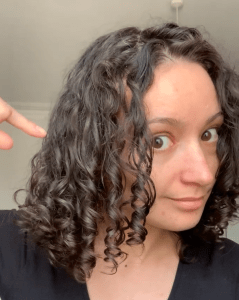
Once your hair gets healthier, you might find that your hair doesn’t need as much conditioning as it used to. Moisture overload (aka overconditioning) means that your curls have become too soft and are now struggling to hold their structure. Although this doesn’t damage the hair, your curls might feel limp and stretched out, and your scalp might be getting greasy faster if you’re using heavy products.
In this case, you need to cut back on the amount of conditioning products you’re using and maybe switch to some more lightweight and/or proteiny products. Don’t forget to clarify too, to ensure your scalp is free of buildup. Check out my post on fixing overconditioned curls for more info on this!
How can you tell if your curly hair needs protein?
As mentioned, our hair is made of protein, so it’s often added to products that claim to repair or strengthen the hair. Your hair might benefit from protein if it’s damaged, as protein ingredients form a film around the hair strands, which in turn helps patch up the holes in our cuticles caused by that damage. Fine hair often benefits from protein too, because the strands are naturally weaker, so it helps the curls hold their structure.
Curls that need protein can have the signs of overconditioning mentioned above: your hair can feel overly soft, have a lot of fluffy halo frizz, and your curls may be limp or struggling to hold their definition. Incorporating some products that have proteiny ingredients higher up their ingredients list, doing a protein treatment, or adding protein drops to your existing products will help add that structure back into your curls and improve your definition and hold.
What does too much protein look like?
Lots of curlies have reported experiencing a type of “protein overload” when they use too many proteiny products, where their hair feels rough and brittle, and they get a lot more “angry” frizz. Some cosmetic scientists believe that this is a bit of a misnomer, because proteins are actually a form of secondary conditioner, and our hair is 95% protein. How can we overload on something that the hair strand is made of?!
There doesn’t seem to be a huge amount of research in this area, but perhaps protein overload is actually a form of underconditioning: your hair is being coated with a conditioning product that just isn’t cutting it for your strands, or not enough of the conditioning agents are attaching, meaning your strands don’t have that soft, lubricated feel.
Still, if your hair does get rough and “angry” after using protein products, simply clarify and switch to some protein-free or richer/more conditioning products. Whatever the formulation, conditioners help protect and lubricate our hair strands – it’s just a matter of finding the right one for you!
Which curly hair products are moisturising?
If you’re wondering whether a product is going to be moisturising, look for the conditioning agents. The more conditioning agents a product has, the more moisturising it’s going to be. Conditioning ingredients include humectants (such as glycerin and panthenol), cationic sufactants (such as behentrimonium chloride), silicones (such as dimethicone), and emollients (such as oils and butters). It is this last group that tends to make a product “heavy” for finer hair types.
My favourite moisturising (protein-free) curly hair products
Cleansers/co-wash:
As I Am Coconut Co-wash
Bouclème Hydrating Hair Cleanser (use code COAST15 for 15% off)
Conditioners:
Noughty Wave Hello Conditioner
Bouclème Curl Conditioner (use code COAST15 for 15% off)
Deep conditioners:
Bouclème Intensive Moisture Treatment (use code COAST15 for 15% off)
Stylers:
Bouclème Super Hold Styler (all of Bouclème’s gels are protein-free. use code COAST15 for 15% off)
Only Curls Mega Hold Curl Gel (use code COAST5 for £5 off)
How do I know if a curly hair product contains protein?
As mentioned, proteins are also a type of conditioner, but they are classed as a secondary conditioner. Whatever the science behind it, I know that my hair definitely likes products that have proteins in, so if you are looking for a proteiny product too, look for “hydrolysed XXX protein”, keratin, or amino acids in the ingredients.
But don’t get tricked by marketing – some products are marketed as proteiny, but actually have a bunch of heavy conditioning ingredients included in the formula too, which could still make your hair overconditioned. The higher up the ingredients list the protein products are, the more proteiny a product is.
Also, be sure the proteins are hydrolysed – this means that the molecules have been broken down enough to be able to penetrate or attach to the hair. This is why it’s not advisable to do DIY treatments like putting egg or mayo on your hair – the molecules in food are too big to have much effect on our hair.
If you’re ever unsure about ingredients, copy the ingredients list and paste into isitcg.com. This will give you a rundown of what most of the ingredients are in a product (and whether the product is Curly Girl Method compliant, if you want to be strict about that).
My favourite curly hair products that contain protein
Shampoos:
Nylah’s Naturals Strength & Shine Thickening Shampoo (this is pretty moisturising too, though)
Hair Dance Clarifying Growth Shampoo (use code 10NATALIE44 for 10% off)
Conditioners:
JSL Essentials Lavender, Geranium & Ylang Ylang Leave-In Hair Cream (use code COAST15 for 15% off)
Hair Dance Strengthening Growth Conditioner (use code 10NATALIE44 for 10% off)
Protein treatments/drops:
Aphogee Two-Step Treatment (works like a hair mask)
Bouclème Protein Booster (add to any hair product: use code COAST15 for 15% off)
Stylers:
TréLuxe Hi! Definition Styling Gel
Ouidad Advanced Climate Control Heat and Humidity Gel, Stronger Hold
Curlsmith Bouncy Strength Volume Foam
If you want to see the difference that protein and over-conditioning has on my hair, check out my series of posts on Instagram about this topic!

 Curls by the Coast
Leave a reply to Dimi Grillo Cancel reply