
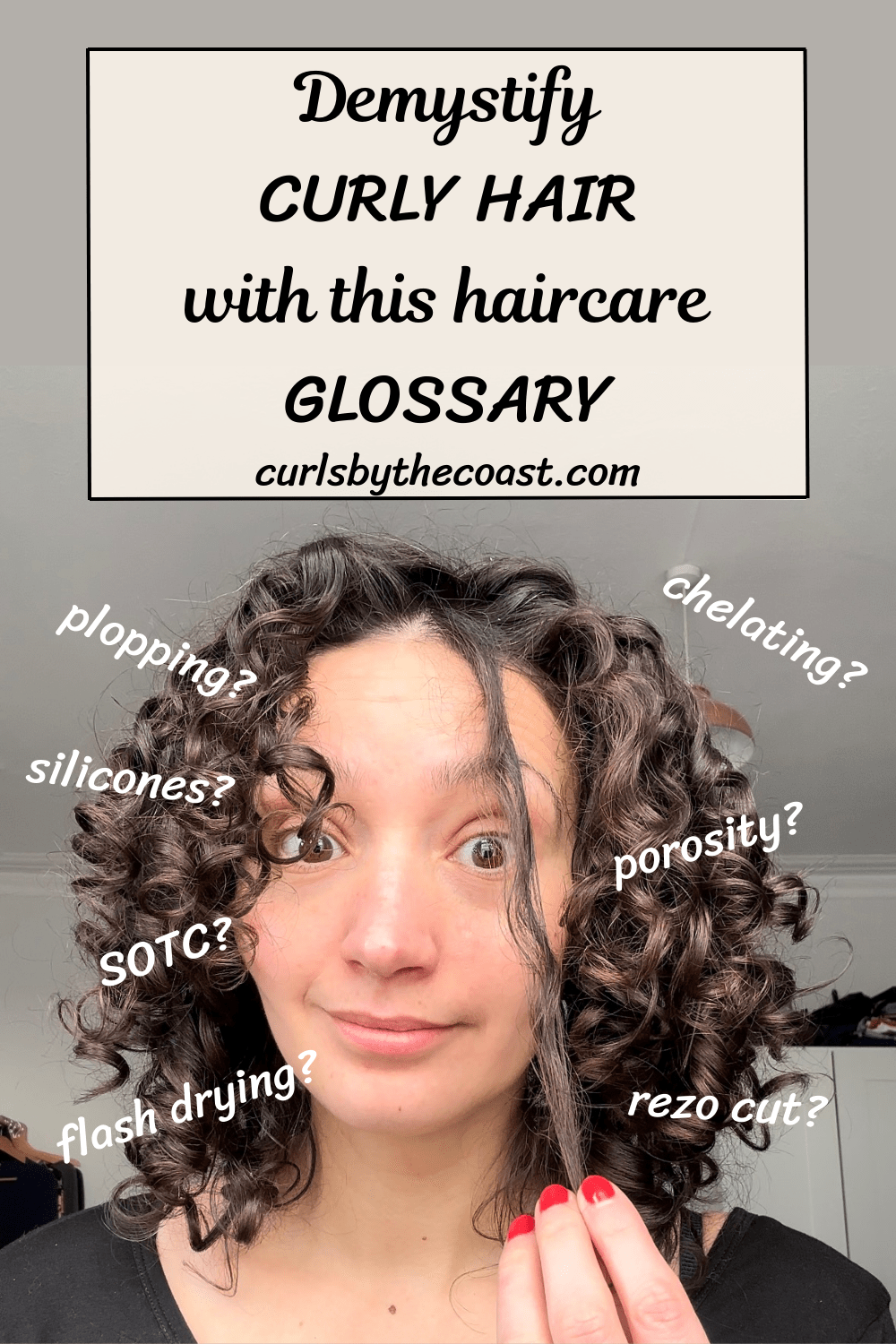
Have you just started to research curly haircare and discovered a whole world of freaky new words? Why is everyone talking about “squish to condish”? What is my “curl type”? And do I even want to know what “plopping” entails?
Well, don’t worry, because I have compiled as many haircare and curly terms that I could think of into this big-ass dictionary! Have a browse through, and soon enough, you’ll be fluent in curly!
Use the “find” function on your browser (or the search bar on my website) to make searching for terms faster! Also, let me know if you think I’ve forgotten any words!
Anagen phase
The longest phase of a hair growth cycle, where your hair follicles produce new hair shafts (strands) and your hair actively grows. Your hair grows about half an inch a month, and can grow faster in summer than in winter. This phase lasts 3-5 years on average and is followed by the Catagen phase.
Bond builders
Hair products that repair the disulphide bonds in the hair shaft, making the hair stronger. These bonds are weakened and broken when the hair undergoes chemical damage, such as bleaching and colouring. The most popular bond builders on the market include Olaplex and K18.
Bowl method
A styling method for curls or waves that involves squeezing and dipping your hair into a bowl while you are styling, so that your hair can be as hydrated as possible and pick up as much product as possible. Lots of people find this gives them great curl definition!
There are two ways to do this: one method was popularised by @powerdomi and the other by @curlyzia.xo, both on Instagram.
Dominique’s method: After shampooing and conditioning, grab an empty bowl. Apply your styler (ideally gel) upside down onto soaking wet hair, then scrunch your hair so that the water falls into the bowl. Now, dip your hair back into this water/gel mixture, and scrunch again. Repeat until the gel feels well-distributed.
Zia’s method: After shampooing and conditioning, fill a bowl with water. Rake through a leave-in or cream, and dunk your hair into the bowl of water. Scrunch your hair when it comes out, so the water falls back in. Repeat 4 times, then apply your styler (do not dunk your hair again after this).
Breakage
Breakage happens when the hair is physically damaged or manipulated in such a way that the hair strands start to snap. This can be caused by many factors: overusing heat tools such a straighteners, pulling hair too hard with hairbrushes, tight hairstyles or repeatedly tying it in the same place, as well as medical conditions such as stress and nutritional deficiencies.
Brush styling
A way to style your curly hair with a brush so that your stylers are distributed, your strands are smoothed, and you maximise your definition. There are lots of different ways to do this, and lots of different brushes you can try it with! For a description of some of these methods, check out my post Brush Styling 101: How to use a brush to create smooth, defined curls.
Buildup
Buildup happens when too much of something is deposited on your hair or scalp, resulting in greasy hair, limp curls, frizz, and sometimes bigger issues further down the line such as scalp issues. Buildup can be caused by products, especially very oily, heavy or conditioning products, as well as the minerals found in hard water. Clarifying and chelating regularly with a suitable shampoo can remove buildup and give you a clean slate to condition and style on. For more about this, check out What is clarifying and why is it important for curly hair?
Catagen phase
A short transitional phase in the hair growth cycle that follows the Anagen phase, in which the hair stops actively growing and the hair follicles become dormant. This phase lasts from 7-10 days and is followed by the Telogen phase.
Cast
The stiff, crunchy shell that can form on your hair after using stylers just as mousse or gel. This is nothing to worry about – you can scrunch out the crunch to get rid of it and release the soft curls within!
Chelating
In haircare, chelating refers to removing mineral and metal buildup caused by hard water and chlorine. Chelating shampoos are also clarifying (see below), but not all clarifying shampoos are chelating. Some chelating agents that appear in shampoos include Trisodium Ethylenediamine Disuccinate, Sodium Phytate/Phytic Acid, Disodium EDTA and Tetrasodium EDTA.
Clarifying
Clarifying is when you use a clarifying shampoo to deeply cleanse your hair from buildup. Clarifying shampoos contain stronger cleansing agents than most sulphate-free shampoos, although nowadays there are many sulphate-free clarifying shampoos on the market. It is recommended that you clarify at least once a month, depending on how much product you use and whether you are prone to buildup. For more about this, check out What is clarifying and why is it important for curly hair?
Coarse hair
See Hair texture.
Cortex
The middle layer of the hair shaft which contains most of the hair’s pigment (colour). It is made of tightly-packed layers of keratin.
Cruelty-free
This means that the finished product has not been tested on animals. To ensure that a product has not been tested on animals at any stage of production (including the individual ingredients), look for products that hold the Leaping Bunny certification.
Curl clump
A group of hair strands that gather together to form a curl. These are different sizes for different people, and it is what gives curls their definition. Your curl clumps form when you’re styling, and can be encouraged with things like techniques like brush styling or praying hands.
Curl type
The shape of your curl (also known as your curl pattern), which is often divided into 4 ‘types’ – type 1 is straight, type 2 is wavy, type 3 is curly, and type 4 is coily/kinky. There are also other sub-categories (a, b & c) for each type. This chart was thought up by hairstylist André Walker to help market his own haircare line, but it has been criticised for being unscientific and for not considering other factors that make up our hair (see hair texture and porosity). For more about this, check out my post Your curl type isn’t as important as you might think.
Curly Girl Method
A method for washing, conditioning and styling your curls devised by Lorraine Massey. Her method focuses on conditioning and does not allow the use of sulphates, or lathering shampoos, silicones, brushes or combs. Although many people come to first find out about curly haircare through the CG Method, it does not necessarily work for everyone and many people find it useful to tweak it to suit their own hair type and lifestyle. For further reading, check out why I believe The CG Method is not for Everyone.
Cuticle
The outermost layer of the hair shaft, made up of keratin proteins that overlap one another, a little like roof shingles. When hair is damaged, holes appear in the cuticle which increases the hair’s porosity. Conditioning products and hair masks help to coat the cuticle and fill in these gaps.
Deep condition
Using a thicker conditioner or hair mask that stays on your hair for between 5-30 minutes. These penetrate the hair and provide more intense conditioning, which is essential for damaged or dehydrated hair. Not all curly hair needs deep conditioning: if your hair is untreated and with minimal damage, or feels very soft, you may find that deep conditioners are not needed in your routine.
Density
This refers to how thick your hair is overall, which is determined by how many hair follicles you have on your scalp, rather than how thick the individual strands are (that’s your hair texture). Obviously you can’t count your hair follicles, but the more visible your scalp is and the thinner your ponytail is, the lower-density your hair is. The less visible your scalp is and the thicker your ponytail is, the higher-density your hair is.
Dermatologically tested
The product was tested by a qualified dermatologist, usually to assess how the skin reacts to the product.
Deva cut
A hair-cutting technique developed by Lorraine Massey, who coined the Curly Girl Method. The hair is cut dry in a round shape, curl-by-curl, and face-framing pieces are added. See also: What’s the difference between a Deva cut, Rezo cut, Cado cut and Ouidad cut?
Diffusing
Using the bowl-shaped diffuser attachment on a hairdryer to dry your curls, which can help reduce frizz and sometimes gain volume. You diffuse by cupping your curls in the diffuser and bringing it up to your scalp, holding for a few seconds, then dropping it and moving to the next section. There are also some alternative methods:
Hover diffusing: holding the diffuser away from your head and hovering the hair dryer over it, without touching your hair. This is ideal if you find that regular diffusing causes you too much frizz, or if you want a more elongated effect on your curls.
Pixie diffusing: keep the hairdryer switched off while cupping your curls in the diffuser, and only switch it on once you’ve gathered it to your roots. Hold it in place for 10-20 seconds, then switch it off again before moving sections. This can help reduce frizz.
For visual aids, check out How to diffuse your hair for defined (and voluminous) curls.
Double cleansing
The old “lather, rinse, repeat” – shampooing your hair twice to really ensure that you are removing buildup, dirt and oil. This may not be necessary if you are using a stronger shampoo, but lots of people find that it really helps to ensure that their hair is clean and shiny.
Drying alcohols
Also known as short-chain alcohols, these are alcohols with a low molecular weight. That are often used in cosmetics as a solvent or to create a quick-drying formulation. Their low weight means they evaporate quickly, but on curly hair this can sometimes create a drying effect. Examples of short-chain alcohols include ethanol, propanol, alcohol denat., and isopropyl alcohol. See also: Are alcohols bad for curly hair? Here’s the difference between “drying” and fatty alcohols
Emollients
Sealing agents that trap moisture and seal the hair, but also help to soften, lubricate and protect.
Emollients are great for curly hair as they combat dryness, but too much at once (or not washing them out properly) can lead to build-up on finer hair. Examples of emollients include jojoba oil, cetearyl alcohol, and cetyl alcohol.
Exogen Phase
The final stage of the hair growth cycle, where the hair strands are released from the hair follicles and your hair naturally falls out. The hair growth cycle then starts again from that follicle (see Anagen phase). We naturally lose between 50-150 hairs a day through the Exogen phase, most of which you’ll see come out when you brush or wash your hair.
Additional hair loss can happen for various reasons, such as stress, malnutrition, hormonal changes, or illness. When your body is under this stress, the Anagen (growth) phase is cut short, resulting in more hair entering the Telogen (resting) phase at the same time. As a result, during the Exogen phase, a few months later, more hair falls out at the same time. If you are experiencing an unusual amount of hair loss, your first port of call should be a doctor.
Fatty Alcohols
Also known as long-chain alcohols or moisturising alcohols, these are alcohols that add a conditioning or lubricating effect to a product, or make it thicker. Fatty alcohols have a long chain of carbon atoms, making them heavier than short-chain alcohols.
Fine hair
See Hair texture.
Finger coiling
A styling method where you twirl a clump of hair around one finger to increase curl definition.
Finger rolling
A styling method that involves wrapping a strand of hair around your finger and then incorporating a finger on your other hand to “wind” the hair up to the root. This can create really defined ringlets, although it takes some practice to get right.
Flash drying
The dry feeling you get when you apply a product and it suddenly feels like all of the moisture is sucked out of your hair. Your hair might feel frizzy, stiff, or tangly again. This seems to be caused by certain film-forming ingredients such as aloe, or certain oils. It is also more likely to happen if you have buildup. If this happens to you, it’s worth checking when you last clarified, and then try applying the product a different way, such as using a leave-in or cream underneath.
Flyaways
Small strands of hair that stick up instead of lying flat. This could be frizz (see below), hair breakage, or it could be new hair growth.
Follicle
A hole, kind of like a pore, through which a hair strand grows. The more circular a hair follicle is, the straighter your hair is, whereas the more oval or D-shaped it is, the more wavy or curly your hair strands will grow. The follicles go through a natural cycle of growth, rest and shedding.
Frizz
Small strands of hair that do not align with the rest of your hair. Frizz can be caused by many factors, and contrary to popular belief, the reason your curls are frizzy is not necessarily because they’re dry. Frizz can indeed be caused by a need for more conditioning (such as a deep conditioner), but it can also be caused by overconditioning (especially if it’s very soft halo frizz), environmental factors such as sun damage or humidity, friction (such as sleeping or wearing a hat), buildup, or improper styling. For more in-depth information, check out Why your curly hair is frizzy (and how to fix it).
Glycerin
See Humectants.
Grit
A kind of textured, almost-producty feeling in your hair that is left by certain styling products. Grit can be very handy for fine hair or overly-soft hair that loses its curl or volume easily, as this texture helps the curl to hold and can retain volume. The downside is that it makes your hair less “touchable”. Products that provide grit include hairsprays, texture sprays, salt sprays, dry shampoos, and certain gels, mousses and foams.
Hairfall
See Exogen phase.
Hair texture
Your hair texture is determined by how thick your individual hair strands are. It generally falls into three categories: fine, medium, or coarse. To determine it, roll a single strand of hair between your fingers. Fine hair strands feel so thin that you can barely tell you’re holding it, whereas coarse hair is much thicker ad can almost feel like a piece of thread. As fine hair is weaker, it tends to get buildup faster and struggles to hold a lot of product. For more information about this, check out my post 5 curly hair tips that may not apply to fine hair.
Halo Frizz
The light frizz that you get over the top layer of your hair, especially on your crown and roots. See Frizz.
Hard water
Hard water contains high levels of minerals such as calcium, which can cause dry skin and buildup on the hair. Using a shampoo containing chelating ingredients can help combat this. For more information, check out How hard water (or soft water) can affect curly hair.
High-density hair
See Density.
High-porosity
See Porosity.
Hover diffusing
See Diffusing.
Humectants
Humectants are ingredients that attract and hold water. In hair products, they help retain moisture in the hair and can make our curls bouncy and conditioned. Examples include glycerin and propylene glycol.
In high humidity, some humectants may draw in too much water from the air, leading to frizz. On the flipside, in very dry and arid environments they may draw moisture out of the hair, making it dry and brittle.
Film-forming humectants are humectants that form a film over the hair, sealing in moisture while also preventing additional moisture from entering. These are often found in weather-proofing and humidity-fighting hair products. Aloe vera, carrageenan, and panthenol are examples of film-forming humectants.
Hydration
In curly haircare, ‘hydration’ is used to mean ‘to get water into the hair’ but some haircare brands also use it in marketing as another word for smooth, moisturised, or well-conditioned. In actual fact, ‘hydation’ is more of a skincare term, and hair strands do not need a lot of water inside them in order to be healthy. In fact, as water makes our cuticles swell, healthy hair should be repelling water as best it can. The paradox is, most curly hair products need a decent amount of water in order to work well, and there is definitely a correlation between styling on wet hair and getting nice, juicy curl clumps.
Hygral fatigue
There is not a lot of scientific evidence that hygral fatigue is even a thing, but in general, it is described as damage to the hair caused by the hair cuticles constantly swelling and shrinking from contact with water. One study from 2011 has found that air-drying hair for a long time caused more damage to the cell membrane of the hair compared to hover diffusing with a hair dryer from a distance of 15 cm, which has led people to believe that it is more damaging to air-dry your hair for several hours, or to sleep with wet hair, than it is to diffuse it. Hygral fatigue is also often confused with overconditioned hair. However, as mentioned, there are no scientific studies on the existence of hygral fatigue and its effect on hair.
INCI
INCI stands for International Nomenclature of Cosmetic Ingredients, and it refers to the guidelines used to identify ingredients in cosmetics (basically, it’s your ingredients list on the back of the bottle). It aims to create a system with standardised names for ingredients, and having the ingredients listed in order of highest concentration to lowest.
LOC method
A styling technique for curly or coily hair that stands for ‘Liquid (or leave-in), Oil, Cream’, where you apply your products in this order in order to get well-moisturised curls. This works especially well for people with high-porosity or damaged hair. There is also the LCO method, which has you swap the order of the cream and oil.
Low-density hair
See Density.
Low-porosity
See Porosity.
Medium-density hair
See Density.
Medulla
Known as the ‘marrow’ of the hair, the medulla is the soft innermost layer of the hair shaft, and is sometimes not present in very fine hair.
Microplopping
See Plopping.
Moisture overload
See Overconditioned hair.
Occlusives
Sealing agents that create a barrier to trap moisture in the hair (or skin). They are hydrophobic (repel water) so can protect curls from extra frizz and water.
Some oils are heavier than others and may look greasy on certain hair types or cause buildup if overused. Examples include beeswax, lanolin, and mineral oil.
Overconditioned hair
Overcondtioned hair (aka over-moisturised hair or moisture overload) happens when you use too many conditioning products in your routine unnecessarily, or that you are using products that are too heavy for your hair type. As a result, your hair struggles to hold its curl, and can feel limp, overly soft, and have a lot of fluffy halo frizz. This doesn’t damage your hair, but it can lead to buildup. The solution is usually to clarify well, cut out some conditioning steps from your routine, and/or switch to more lightweight products. You can also add protein to give your curls added structure. For more information, read Can you over-condition curly hair? Signs of moisture overload and how to fix it.
Parabens
A group of chemicals that are used as preservatives in cosmetics. In recent years, there has been fears among consumers that parabens cause cancer, but studies suggest that the low amounts that are used in cosmetics, coupled with the fact that we only apply these products topically (to the surface of the skin rather than ingesting them), means that there is not enough evidence to suggest that parabens in cosmetics are dangerous to us. However, many brands have responded to this consumer concern by reusing different (albeit sometimes less-tested) preservatives in their products and marketing them as paraben-free.
Parietal whorl (aka cowlick)
The section of your hair near the crown that grows in a circular pattern. In people with low-density hair, this can look like a bald patch, but it is really just the central point from which your hair is growing and everyone has one. Some people can have two whorls (known as having a double crown).
Pixie diffusing
See Diffusing.
Plopping
A way of gently removing water from the hair without rubbing the hair or causing too much damage. It involves blotting your hair with a towel (or, ideally, a flat-weave fabric to avoid excess friction), and can help enhance curl definition. You can do this either before or after applying your styling products – both will give different results.
Dry plopping: this is the “normal” way of plopping, where you concertina your curls into a towel or t-shirt and tie it around your head. You can leave this on for a couple of minutes until your hair stops dripping, or for longer after styling to speed up air drying.
Microplopping: instead of wrapping your hair in your towel, you cover your hands in the towel and gently scrunch your curls with it. This can help you remove water in a more targeted way (e.g., reaching the roots better) while further enhancing your definition.
Wet plopping: this is when you put a shower cap on your head for a couple of minutes after you are done styling, while your hair is still wet. This gives your styler a chance to adhere to your hair, so that it doesn’t all get blotted away with the regular plopping motion afterwards. You can follow this up with dry/microplopping depending on your preference.
Porosity
Porosity refers to how “porous” your hair is, i.e. how much water it lets in. This is determined by how many holes are in your cuticle, and therefore porosity is directly linked to damage. The more damaged your hair is, the more porous it is, because it both takes on and loses moisture quickly. Contrary to popular belief, it’s quite hard to determine your porosity, and it is possible for different sections of your hair to have varying levels of porosity. For more information about the role pororsity plays in a curly hair routine, check out What is hair porosity – and does it really matter for curly hair?
Praying hands
A styling method that refers to applying product by smoothing your hair while it is sandwiched between your flat hands. This motion can help you form your natural curl clumps (without breaking them up as raking can do), while distributing the product more evenly.
Protein
Protein in haircare refers to a group of film-forming, secondary conditioning agents that are often added to hair products to add strength, structure, and repairing qualities to the hair. In curly haircare, protein ingredients can enhance your curl definition and strengthen fine or damaged hair. These ingredients include hydrolysed keratin and hydrolysed oat/soy/rice/silk/pea protein. Our hair is also made up of proteins.
Protein-moisture balance
A concept in curly haircare that suggests that curly hair either needs moisture (or conditioning, which softens the hair) or protein (which strengthens the hair) in order to get balanced curls. In reality, they do not balance like a see-saw, and it is possible to need both – especially if your hair is damaged. For an in-depth explanation of this, check out What is the protein-moisture balance? Everything you need to know for balanced curly hair.
Protein overload
An anecdotal issue where people have reported dry, brittle curls when they use products containing too much protein. Since proteins are also conditioning agents, protein overload is likely either a form of buildup, or a form of underconditioning, where your hair needs more primary conditioners (such as emollients) and the proteins are just not cutting it for your hair. In either case, using a clarifying shampoo, followed by a different, perhaps more moisturising conditioner, should sort the problem out.
Raking
A styling method where you use your fingers to comb through your hair. This can be used as a gentle way to detangle when you have conditioner on, or as a way to distribute styler before scrunching.
Rezo Cut
A dry curly haircut invented by Nubia Rëzo that creates an even length of curls around your head while giving the hair body and shape. Further reading: What’s the difference between a Deva cut, Rezo cut, Cado cut and Ouidad cut?
Root clipping
Adding clips to the top parts of your hair to lift the root and encourage volume. There are many ways to root clip, as well as many different clips you can use.
Sebum
The natural, oily substance produced by our hair glands, which helps protect the skin barrier of the scalp. The amount of sebum produced varies from person to person, and can make some people’s hair get greasy faster. It is a myth that you can “train” your scalp to produce less sebum, but by shampooing effectively and more frequently, you can prevent sebum buildup which can lead to other skin problems.
Scrunching
A method for enhancing curl definition where you cup your curls with your hands and squeeze them upwards, ideally pulsing with your fist at the end. This is mainly done with a styling product such as a mousse or gel, which will help hold the shape and protect the curls.
Scrunch out the crunch
Often shortened to SOTC, this is a handy little rhyme to remind you what to do when you end up with crunchy, stiff curls. This stiffness is called a cast, and it is left by styling products. Scrunching your hair when it is fully dry breaks this cast, and releases the soft curls within.
Shedding
See Exogen phase.
Silicones
A group of synthetic polymers that are added to hair products for conditioning or heat protection purposes. They coat the hair like other conditioning ingredients, creating a protective barrier and helping to retain moisture. The CG Method forbids the use of silicones because it claims that they can’t be washed out of the hair, and while they can cause buildup (as do many other conditioning agents like oils and butters), if you are shampooing properly and incorporating clarifying into your routine, they are nothing to worry about. Examples of silicones include Dimethicone, Amodimethicone, Cetyl Dimethicone, Cyclopentasiloxane, and Dimethiconol.
Sleep protection
Any method that is used to protect curls from friction while you sleep. The most popular sleep protection is a bonnet and/or a silk/satin pillowcase, but alternative include buffs or hair wraps, silk scarves, or just tying your hair into a high ponytail with a gentle scrunchie, or clipping parts of your hair out of the way (Medusa clipping). Check out The importance of sleep protection for curly hair for more methods and recommendations.
Smasters
A technique where you glaze a little more styler over your curls halfway through drying, to reduce frizz and increase hold. This method was popularised in a curly forum by someone with the username Smasters, hence the name!
Split ends
Split ends are when the ends of your hair shaft split due to damage. Split ends are caused by heat damage (e.g. using straighteners or tongs), as well as from overwashing or underconditioning your hair. While there are some products on the market that can reduce the appearance of split ends, there is not product that can properly repair them. The only way to get rid of split ends is to cut them off.
Squish to condish
A method of conditioning your hair that ensures that your conditioner is well-distributed and that your hair has enough slip for detangling. It involves squishing palmfuls of water into your hair after you have applied your conditioner, which helps distribute the conditioner and often gives a slippery, seaweed feeling to your hair. This state makes it ideal for detangling, and is also a sign that your hair is sufficiently conditioned.
Sulphates
A group of cleansing agents (surfactants) found in shampoos, that create a lathering effect when mixed with water and help remove dirt and oil by binding to it before being washed away. Examples of sulphates include Sodium lauryl sulfate (SLS), Sodium laureth sulfate (SLES), and Ammonium lauryl sulfate. The CG Method forbids sulphate shampoos because it claims that they are drying, but while sulphate shampoos are often clarifying and can still sometimes be harsh for certain hair types, it is the overall formulation that counts, and some shampoos containing sulphates can still be very moisturising if they contain other conditioning ingredients.
Telogen phase
The resting phase of the hair growth cycle, where the hair strands remain in their hair follicles but are no longer growing. This phase lasts for around 3 months, and around 10% of your hair is in the Telogen phase at any given time. This phase comes after the Catagen phase and is followed by the Exogen phase.
Terminal hair length
The maximum amount your hair can grow before the hair falls out or is cut or damaged. This is determined by genetics, and your own hair growth cycle, and explains why some people can grow their hair down to their bums, whereas other people’s seems to struggle to get past their shoulders.
Type 1 hair
Straight hair. See Curl type.
Type 2 hair
Wavy hair with a loose or tight S-shaped pattern. See Curl type.
Type 3 hair
Curly hair which spirals into a helix shape. See Curl Type.
Type 4 hair
Kinky or coily hair with a very tight curl or zigzag shape. See Curl type.
Vegan
In haircare, ‘vegan’ describes a product that is free of animal products.
Wet plopping
See Plopping.
 Curls by the Coast
Share your thoughts…