
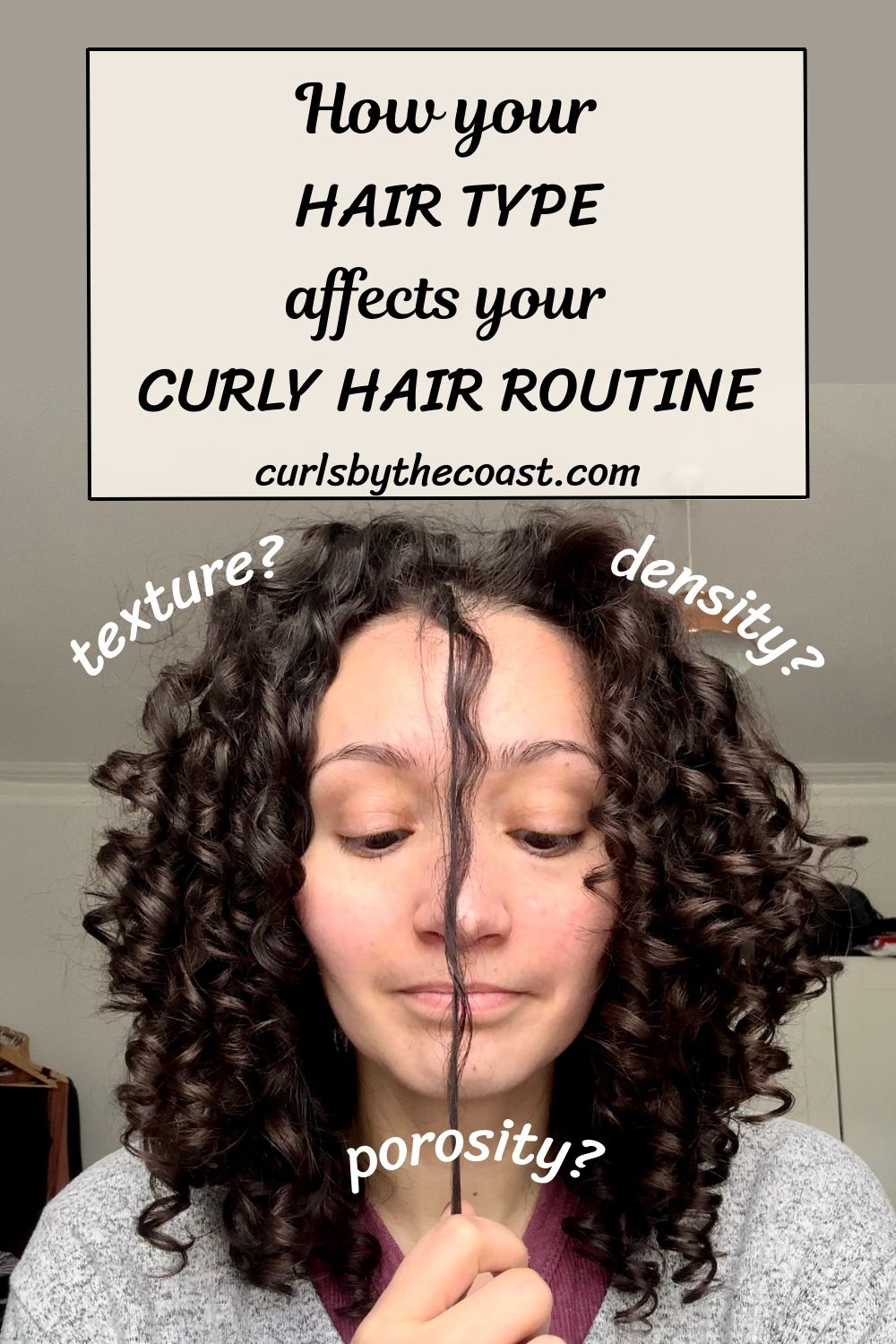
The reason why there can’t be a one-size-fits-all approach to curly haircare is because everyone has different characteristics in their curls. And no, I’m not talking about curl type: I explain here why that’s one the least important factors to take into account!
Instead, you need to assess your hair texture, porosity, and density, so that you can tweak your routine accordingly and give your curls the best results.
Hair texture (fine, medium or coarse hair)
When we talk about hair texture, we are actually talking about whether your individual strands are fine, medium or coarse. In my opinion, this is the factor that will most dictate what curl products you should be using, and which ones you should use less of or avoid.
How can you tell if you have fine or coarse hair?
To find out whether you have fine or coarse hair, simply take an individual strand of hair and feel it between your fingers. If you can barely feel the strand, your hair is likely fine, whereas the thicker the strand is, the coarser your hair is.
How does your hair texture affect your curly routine?
Fine hair generally has little to no cortex (the middle layer of your hair, composed of keratin), which makes it weaker or more fragile than coarser hair. This means that fine hair can often look limp and flyaway, or get weighed down or greasy faster as it can’t take on as much product.
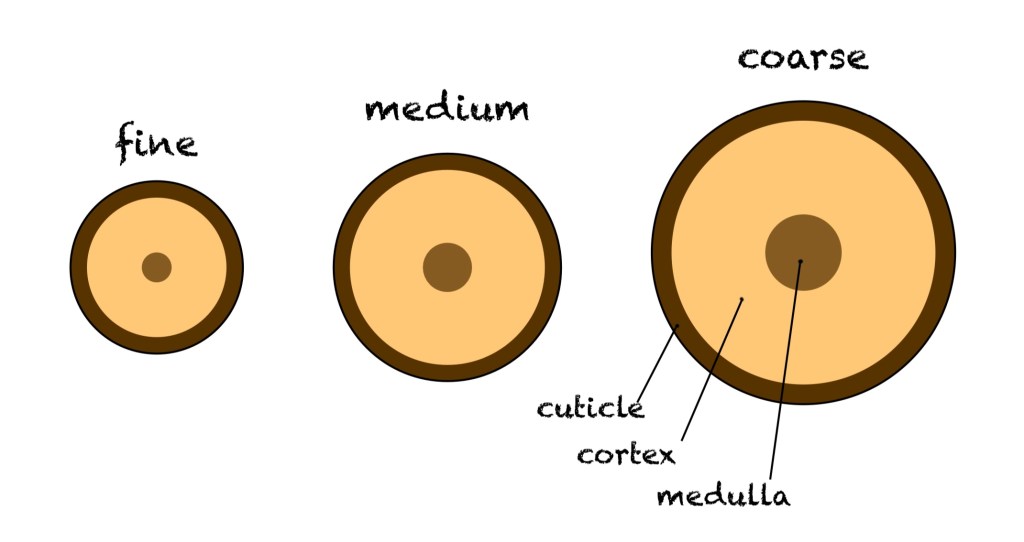
This means that lightweight products are key for fine curls! It also means that overdoing it on the conditioning products, such as using a heavy conditioner, frequent deep conditioning, and adding leave-in and curl cream, can easily be overkill. You may need lots of conditioning at first, especially if your hair is heat or chemically damaged, but if your curls start to fall flat and limp, this could be a sign that you can ease off the conditioning.
Fine hair can often like protein products too, because protein adds strength and structure to our weak strands.
On the other hand, coarse hair can hold onto more product, but it might also be dryer. Coarse curls get on better with more conditioning products in their routine, from cleansing through to styling. It can also benefit from more frequent deep conditioning, and incorporating a curl cream underneath your hold styler (gel/mousse) to really hold that moisture in.
See also:
High, medium or low density
People often confuse having thick hair with having coarse hair, but it is possible to have fine, high-density hair! Your density refers to how many hair follicles you have, rather than how thick the strands are. The more hair follicles you have, the higher-density your hair is.
How can you tell if you have high or low-density hair?
This one is luckily an easy one: the lower-density your hair is, the more of your scalp you can see. If you can hardly see your parting, then it’s higher density. If you are someone who feels like you could land a plane on your parting, or who struggles to wear a half-up-half-down hairstyle because it feels like you only have four hairs left underneath, you likely have lower-density hair.
How does your hair density affect your curly routine?
Your hair density won’t affect the type of products you use, but it might affect how much product you need and how you apply it. If you have low-density, thin hair, you won’t need to apply as much conditioner or styler, whereas if you have higher-density hair, you might find you have to section your hair to apply your shampoo conditioner and stylers effectively. Check out Curls with Alexa below, who definitely has high-density hair:
High, normal or low porosity
Possibly the most confusing hair characteristic to get your head around, your hair porosity actually relates to how damaged your strands are. High porosity hair has more “holes” in the cuticle, meaning that it takes on and loses moisture faster, whereas low porosity hair has more integrity in the cuticle which slows that loss (and intake) of moisture.
This means that medium, or “normal” porosity is pretty common – we all have a little damage just from day-to-day wear and tear.

How can you tell if you have high, medium or low porosity hair?
Lots of websites recommend a porosity test where you take a hair strand and put it in a glass of water – but this test is actually flawed and pretty useless as there are too many variables to make it an accurate test.
Since porosity is linked to damage, it’s also possible to have varying porosities around your head. The only true way to see a hair strand’s porosity is by using a microscope, so the best way to get a general idea of your porosity is to think about how damaged your hair is, and how it behaves around moisture.
If your hair is bleached, or recovering from heat damage, it’s very likely high-porosity. If it gets wet really easily and starts to dry as soon as you’ve left the shower, it’s high-porosity too. But if it takes you a long time to get your hair wet and an even longer time to dry it, then it’s on the lower-porosity side.
See also:
How does porosity affect your curly routine?
Higher-porosity curls will need a little extra help retaining moisture, whereas lower-porosity curls might need help actually getting wet and getting the products to stick to the hair and do their job. High-porosity curls are likely to soak up products more easily, whereas low-porosity hair can experience build-up faster (but this will depend on your texture as well).
Once again, your porosity is not related to your hair texture: whether your hair is wavy or curly, you can have fine, high-porosity hair, or coarse, low-porosity hair. Or vice-versa!
Like fine hair, low-porosity hair gets on better with lightweight products, and overly buttery or oily products can be overkill. It’s also worth messing around with styling on soaking wet or wet-but-not-dripping hair, to see which results work best for you.
Wet plopping after styling (putting a shower cap on for a few minutes after you’re done styling) can help your products adsorb onto your hair, whereas diffusing will speed up your drying time and avoid any issues from air drying your hair for hours on end.
High-porosity curls need deep conditioning more often, and get good results with curl creams and sealing their hair with an oil or serum after drying. Whatever helps keep that moisture in! They might also benefit from “repairing” products, such as products that contain protein, or bond builders to help repair the cuticle. As your curls get healthier, you may need to tweak your routine again to accommodate your changing porosity.
Hopefully now you have a better idea of your hair’s characteristics, which will help you to narrow down what kind of routine you need, whether your hair is wavy, curly or coily. Don’t forget that every head of curls is different, so there is always a little bit of trial and error involved before we get consistent results with our curls.
Looking for product recommendations? Check out my faves:
 Curls by the Coast

Share your thoughts…