
Learning how to care for your curly hair can feel a little overwhelming. There is so much information out there, and so many products to choose from! How do you know which curly hair products you need?
Well, I have attempted to make a flowchart to help you figure out what your hair needs! Simply follow the questions below and start building a basic curly hair washday. You’ll notice that I don’t ask what your curl pattern is – because it doesn’t really matter that much! And whether your hair is fine or coarse, the below questions are elements that all hair types need to take into account.
Underneath this flowchart, I’ve added a little extra explanation about the products in each step, along with some of my favourites at a range of price points. Hope it helps!
Please note that some of the links and discount codes below are affiliate, meaning I get a small commission if you use them. I won’t be offended if you search for the products elsewhere, though.
[Click to enlarge]
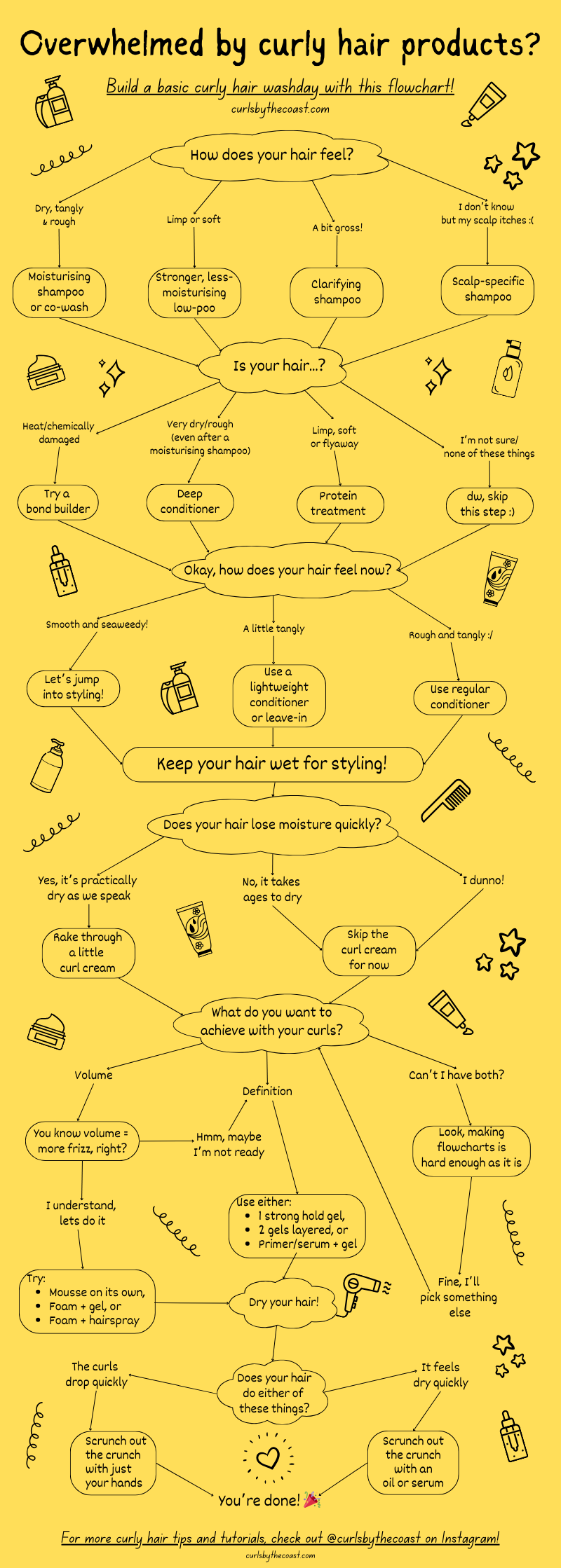
Hopefully by now you know what kind of products you need for your washday. “But I still don’t know which brands to choose!” I hear you cry. Well, the brands available to you will obviously vary from country to country, but below are some of my personal favourites, along with what these products actually do.
Moisturising shampoo or co-wash: When your hair is very dry and damaged, you need all the conditioning you can get! And that includes getting some in your cleansing step, too. Some moisturising shampoos that I enjoyed at the start of my curly journey include:
- As I Am Coconut Cowash
- Ouidad Advanced Climate Control Defrizzing Shampoo
- Noughty To the Rescue Shampoo (get up to 20% off with code LFTFCOAST)
- Bouclème Hydrating Hair Cleanser (get 15% off the website with COAST15)
Stronger, less moisturising shampoo: If you have fine hair like me, it’s easy to go overboard on the conditioning, and over-moisturised hair will make your curls fall flat! That’s why in this case, it’s better to have a less-moisturising shampoo to cleanse with. This doesn’t have to be super drying or stripping, but even if it does make your hair feel a bit squeaky-clean, that’s okay – you will balance it out with your conditioner!
- Only Curls All Curl Cleanser (get £5 off with code COAST5)
- Flora & Curl Superfruit Shampoo
Clarifying shampoo: Clarifying isn’t part of the Curly Girl Method (yet another reason why I don’t follow it) but it is key to maintaining good scalp health and ensuring bouncy curls! The frequency at which you clarify will depend on where you live and how much product buildup you’re prone to, but it’s definitely worth doing a deeper shampoo at least once every few weeks. Check out this blog post for more about clarifying (and also chelating – removing hard water buildup!). The following shampoos are also chelating:
- Noughty Detox Dynamo Clarifying Shampoo (get up to 20% off with code LFTFCOAST)
- Bumble & Bumble Sunday Shampoo (get up to 20% off with code LFTFCOAST)
- Ouai Detox Shampoo
Scalp-specific shampoo: If you have an itchy or flaky scalp, or dandruff, then the key to fixing it will be in your shampoo. Don’t assume that anti-dandruff shampoos are automatically drying; there are plenty of sulphate-free ones on the market that gently but effectively cleanse your scalp.
- Umberto Giannini Scalp Restore Scalp Reviving Anti Dandruff Shampoo (get 20% off the website with code COAST20)
- Curlsmith Wash & Scrub Detox Shampoo
- E45 Dry Scalp Shampoo
Bond builder: Bond builders work by repairing the disulfide bonds in damaged hair, which improves the strength and appearance of your hair. This is great if your curls are chemically damaged, such as being dyed or bleached. But bear in mind that there’s only so much damage that can be covered up with products: for severe damage, or lots of split ends, it’s worth cutting your hair for optimum hair health.
- Olaplex no. 3
- Curlsmith Bond Curl Rehab Salve (get up to 20% off with code LFTFCOAST)
Deep conditioner: Deep conditioning is a must if your hair is prone to dryness, or if you’re at the start of your curly journey and your hair is damaged. Try doing one every 1-2 weeks to start with, and tweak the frequency depending on how your hair feels. Once it starts to get healthier, you might find you need to deep condition less and less frequently.
Protein treatment: Lots of new curlies get confused when they hear about protein, but the basic principle is that it adds strength and structure to your curls, so you may find it useful if your hair is limp, fine, damaged or overly soft. Check out my post on the protein-moisture balance for a more thorough explanation!
Regular conditioner: By “regular” I basically mean using an ordinary conditioner, rather than a deep conditioner or something much lighter (see below). You can use whatever you already have if you like, but I also enjoy these!
- Bouclème Curl Conditioner (get 15% off with code COAST15)
- Noughty to the Rescue conditioner
- Hair Dance Strengthening Growth Conditioner (get 10% off with code 10NATALIE44)
Lightweight conditioners: “Lightweight” products don’t have as many oils or butters, making them better for fine hair or hair that is prone to getting overconditioned.
- Umberto Giannini Repair Juice Conditioning Water (get 20% off with code COAST20)
- JSL Essentials Lavender, Geranium & May Chang Conditioner (get 15% off with code COAST15)
- Noughty Wave Hello Conditioner
Leave-in conditioners: Leave-ins are great for when your hair needs a little somethin’ somethin’ after you’ve rinsed out your conditioner. I actually like skipping conditioner and going straight to leave-in – then rinsing it out! This helps my fine curls get some lightweight conditioning without weighing them down. The three below can be left in or rinsed out:
- TréLuxe Untie the Knot (get 15% off when you buy through this link)
- Shedid & Parrish Silky Leave-In Conditioner (get 10% off with COAST10)
- JSL Lavender, Geranium & Ylang Ylang Leave-In Hair Cream (get 15% off with COAST15)
Curl cream: It feels like curl creams are an absolute staple in every curly girl’s routine, but in actual fact, if you’re struggling to get your curls to hold, you should try skipping it! Still, if your hair dries out quickly and you need help sealing in that moisture, it should definitely be in your arsenal. Just bear in mind that curl creams don’t have a lot of hold on their own.
- Noughty Wave Hello Curl Taming Cream
- Tootilab Soft Leave-In Cream (get 15% off with code CURLSBYTHECOAST)
Mousses: Mousses are perfect for adding volume to your curls! You can either use one on its own, or maybe glaze a little gel over the top for a bit of extra hold. You might actually get the coveted combo of volume and definition with a mousse+gel together! (It was just hard to add to the flowchart, haha!)
- Umberto Giannini Curl Whip Mousse (get 20% off with COAST20)
- Wella Shockwaves Volume Mousse
Foams: Curl foams have really taken off in recent years, yet lots of people are confused about the difference between a mousse and a foam. In general, foams are more lightweight, meaning you can get them closer to your roots without your curls being weighed down. Foams also come in a pump bottle, unlike mousses which are aerosols. However, some brands market their foams as mousses, which is…confusing.
- Bouclème Super Volumising Foam (get 15% off with COAST15)
- TréLuxe Curl Defining Mousse (get 15% off with COAST15)
- Curlsmith Bouncy Strength Volume Foam
Hairspray: I know what you’re thinking: “uh, hairspray? On curls?” Well, it’s not just for slicked-back hairstyles any more: curly brands are starting to release hairsprays that you can spray on wet or dry curls to really lock in that hold! These two kind of behave like spray gels: you could either spray it directly onto your wet hair, or spray onto your hands and glaze it over.
- Bounce Curl Hair Spray (get 10% off with code CURLSBYTHECOAST10)
- Bouclème Flexible Hold Hair Spray (get 15% off with COAST15)
Strong hold gels: Not all gels are built the same, but strong hold is a must for that lasting curl definition. It’s quite hard to find a one-and-done gel, but these are the strongest-hold ones that I’ve tried.
- Curls & Co Soft Curl Gel
- Giovanni LA Hold Styling Gel (get up to 20% off with code LFTFCOAST)
- Bouclème Super Hold Styler (get 15% off with code COAST15)
Gels to layer: Strong hold gels are not the be-all and end-all, and you might find that you prefer a more flexible hold with two medium-hold stylers. These three are my favourite: My best washdays have been when I’ve layered the TréLuxe gel over one of the other two.
- TréLuxe Hi! Definition Styling Gel (get 15% off when you buy through this link)
- Noughty Hey Curl Scrunching Jelly
- Twist Weather-Up Styling Gel
Primer/serums: Primers and serums work in a similar way – they can help hydrate and smooth your strands ahead of styling, which boosts your curl definition. Plus, they’re nice and lightweight, so they can be a good alternative to curl creams for fine hair!
- TréLuxe Soothe and Restore Aloe Vera Curl Primer (also their serum! Get 15% off the website when you buy through this link)
- Noughty Hello Curls Primer
- Shedid & Parrish Curl Control Serum (get 10% off with code COAST10)
Oils to scrunch out the crunch: Once your hair is completely dry (and you might have a stiff shell around your hair), smoothing a few drops of oils over your hair is a good final step for breaking that cast, adding shine and sealing in all that moisture. But you may want to skip it if your hair is already quite soft and prone to dropped curls. Don’t forget that oils do not add moisture to your hair: they won’t help you if you haven’t already hydrated and conditioned your hair earlier in your routine.
- Curl Company Moringa Styling Oil
- The Innate Life Rose Hair Elixir
- JSL Essentials Lavender, Geranium & Ylang Ylang Hair Oil (get 15 off with code COAST15)
Phew! I hope that you now have a better idea of which curly products do what, and that it’ll help you choose the right curly products for you. If you need a hand with styling technique, check out my post on brush styling, my easy beginner’s routine, or my Instagram for videos. Happy hair washing! 🎉
 Curls by the Coast
Share your thoughts…