
A lot of curly advice is based on the assumption that you have coarse hair and thick curls – but what if you don’t? Because of its structure, fine hair (like mine!) needs a slightly different routine to coarse hair…
What is fine hair?
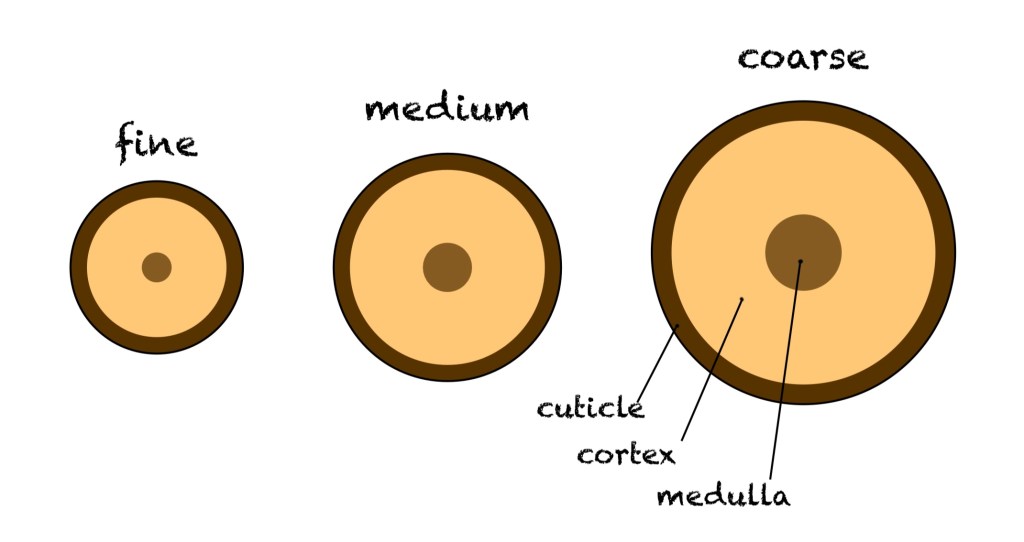
Fine hair refers to the width of your individual hair strands. The smaller or thinner your hair strands feel, the finer your hair is. Fine hair is not to be confused with thin hair (aka low-density hair), which refers to how many hair follicles you have. It’s possible to have fine hair, but lots of it!
Because fine hair generally has a smaller cortex (the middle layer of your hair, composed of keratin), fine hair is often weaker and more fragile than coarser hair. It can also get greasy faster, because it cannot take on as much product.
When it comes to curly hair care, this means you may have to tweak your routine from the “universal” curly tips you usually see. Here are a few examples:
Fine hair could benefit from stronger shampooing or more frequent clarifying
The Curly Girl Method actually forbids the use of lathering shampoos and suggests only co-washing. But with fine hair, this can quickly become overkill and can make our curls limp and even greasy. Fine hair gets buildup more easily than coarse hair, so it benefits from more frequent shampooing, or more frequent clarifying. Try switching to a low-poo rather than co-washing, and make sure your shampoo isn’t super moisturising so that your curls can get some body and bounce.
Fine hair doesn’t need as much conditioning
As mentioned above, fine hair may benefit from not co-washing – but it also doesn’t need as much conditioning as coarser hair types. The only caveat to this is if you have heat/chemically damaged hair – very dry hair can always benefit from occasional extra conditioning, like a deep conditioner.
But don’t feel that you have to follow the “deep condition every week” rule – this might be helpful at the start of your curly journey, but you may find that it’s not needed once your hair gets some of its health back. My hair hasn’t needed a deep conditioner for years – in fact, I sometimes just use a leave-in conditioner in place of my normal rinse-out, and that’s enough conditioning for my hair!
Fine hair can last longer without leave in/cream
Like the above, if you have been following a curly routine where you’re using lots of conditioner, followed by a leave-in and/or cream, but your curls are falling quite flat and limp – this suggests that your hair is actually being overconditioned.
Try cutting down on or cutting out your curl cream or leave-in, and see if it actually gives you better results. It sounds counter-intuitive (after all, curl cream is like, a cornerstone of curly hair care!) but I get better hold by skipping curl creams, and styling with two gels instead for maximum hold. If you find that curl cream does give you a little extra hold or shine, just use a tiny amount instead, so you don’t overdo it.
Your fine hair might love protein
A lot of curly hair care is focused on conditioning, but not all conditioning ingredients are built the same. While primary conditioners, such as butters and silicones, help soften and smooth the hair, protein ingredients are often added to products to “repair” or strengthen the hair. This is great for fine hair, because it’s naturally weaker, and when it comes to curly hair, protein can help add strength and structure to our curls.
Examples of protein ingredients include hydrolysed wheat/soy/rice/silk protein, keratin, and collagen, so look for these near the top of your products’ ingredients. Check out my post on the protein-moisture balance to learn more about protein!
Fine hair might prefer damp styling
Although lots of routines recommend styling on soaking wet hair to get those juicy curl clumps, all that water weight can be heavy! Play around with styling on soaking, wet or damp hair and see which one creates the best results for you. For me, I prefer to style on hair that is wet, but not dripping wet. If it’s too wet, I get more frizz and less volume, and if it’s not wet enough, my results become stringy.
If you have fine hair and are looking for more curl tips, it’s useful to follow people who have a similar hair type to you, as a routine that works great on someone with thick, coarse hair may fall flat on someone with fine, thin hair.
Check out one of my fine hair routines on Instagram:
 Curls by the Coast
Share your thoughts…