

2b, 3c, 4a… newcomers to the world of curly hair care are sometimes a bit hung up on what their curl type is and what products and techniques are best for that curl type. But I consider the curl type chart to be like your horoscope: fun to look at, but don’t let it dictate your whole life. 😆
Below, we’ll look at where this curl typing came from, and how much of a role it should really play in your curly hair routine.
Jump to:
Where did hair typing come from?
There are lots of curl type charts, but the hair chart that you’ll mostly see today originated from André Walker’s Hair Typing System, created in the 1990s by Oprah’s stylist, André Walker. He originally created this chart to market his line of hair care products, so that people could match their hair type to one of his product ranges. On this now-archived part of his website, he divides hair textures into 4 types, with some sub-categories under that. Type 1 is straight hair, type 2 is wavy, type 3 is curly, and type 4 is kinky/coily hair.
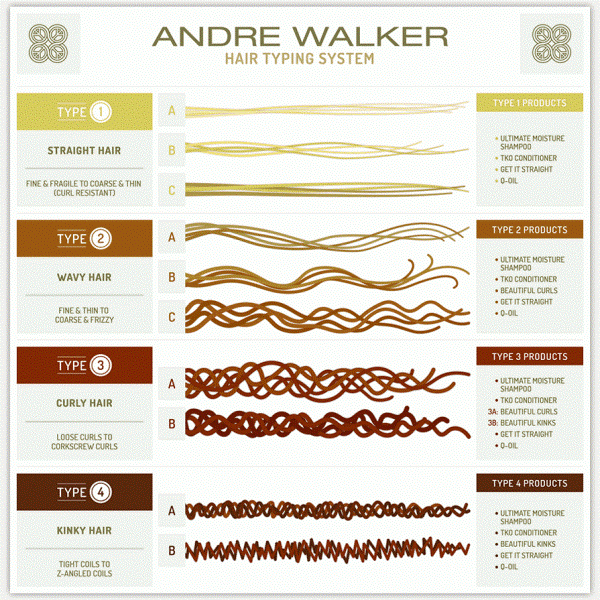
With the resurgence of curly hair care in recent years, the chart has come under a lot of criticism, with people feeling like he created a “hierarchy” for hair texture and puts too much emphasis on straighter hair and looser curl patterns – especially when he recommends his straightening range for all of the curly hair types.
But according to the podcast 99 Percent Invisible, André Walker has explained that “lower numbers being straighter isn’t meant to imply they are better, it’s just a measure of texture from low to high.”
With that in mind, is it still worth using? In my opinion, not really.
Why we need to stop using the curl chart
1. It was only ever meant to be used in conjunction with André Walker’s products
It’s worth remembering that this curl chart was created as a marketing device – it’s not hugely scientific. I believe that this curl chart has been more of a hindrance than a help, with people thinking that the aim is to get their hair as curly as possible, or that waves are “lesser” curls, or that type 4 was added last as an afterthought.
2. You can have a mixture of curl patterns across your head
Your hair texture is determined by genetics – meaning that you could have a mixture of waves and curls, and even some straight bits thrown in. The curl chart tries to put our hair texture into a single box, causing curlies to think that they’re doing something wrong because their curls aren’t uniform, rather than just accepting their hair just as it is in all its diversity!
3. There are more important factors to consider beyond your curl shape
Your curl/wave shape has nothing to do with how fine, coarse, or damaged your hair is, and these are much more important factors to take into account when selecting your curly hair products and techniques. Finer hair thrives on lightweight products and more frequent washing, and coarser hair can handle heavier products – no matter what curl pattern you have. Note that lightweight does not mean “light hold” – you can definitely get lightweight stylers with a decent hold level.
Conclusion
Essentially, the main thing that the curl chart is useful for is for understanding the limitations of your hair texture. If you have wavy hair, no amount of product or technique is going to make it spring into 3c hair one day. When I first started my curly hair journey, I thought that the goal was to get all of my hair to look like the curliest curl pattern I had. I now know that it’s perfectly normal to have a head full of different curl types! Granted, some of my hair did curl more as my hair got healthier, but they are never going to be one uniform shape. That’s the beauty of curly hair, it’s always a surprise 😉
Do you think that the curl chart is more confusing than helpful? Or did it perhaps help you understand your curls?
 Curls by the Coast
Share your thoughts…